Marketing for restaurants often sounds bigger than it actually is. In practice, it comes down to three questions every potential guest wants answered, consciously or not: can they find you, can they easily make a reservation, and is it worth it? If you cover those three well, the rest follows almost automatically.
The problem is that many restaurants try to solve this with "more effort" (more posts, more promotions, more last-minute campaigns), while the biggest gains usually lie in a handful of tools that automate your foundation. Not to make you less personal, but so your team gets even more room for hospitality.
In this article
- Google Business Profile: your most important showcase on Google
- Website + online reservations: the conversion machine you own
- Newsletter software + customer database: repeat visits without an advertising budget
- Reviews & reputation management: trust is your fastest growth path
- Frequently asked questions
1. Google Business Profile: Your Most Important "Showcase" on Google
One of the most important hospitality marketing tools is the Google Business Profile. For many restaurants, the Google Business Profile is simply the first point of contact. Even before someone sees your website, they already see your opening hours, photos, reviews and location. And this often happens with clear local intent: "restaurant nearby", "Italian in Antwerp", "brunch Ghent city centre". That makes this profile not just important, but also extremely "conversion-sensitive".
Google itself states that local results broadly revolve around relevance, distance and prominence. In other words: how well does your restaurant match the search query, how logical is your location, and how strong are your online signals (such as reviews, completeness and activity)?
That is why it pays to treat your profile not as a one-time fill-in exercise, but as something you actively maintain. Especially in the restaurant industry, where seasons, menus and opening hours change regularly, being "up-to-date" is just as important as being "attractive".
Reserve with Google: Fewer Clicks, More Reservations
When "Reserve with Google" is available, you shorten the journey from discovery to booking. The guest no longer needs to search for your reservation page but can book directly from Google Search or Maps. Technically, this works via Google's Actions Center / end-to-end reservation integrations: your reservation system must be able to reliably pass on availability (in real time or via robust synchronisation).
It is important to be realistic about this: it is not always a button you simply "switch on". It depends on your reservation partner and the integrations supported. But when it works, it is a very powerful way to remove friction at the moment someone is already in "booking mode".
Checklist (Google Business Profile, 10 minutes)
- ✅ Name, address and phone number identical everywhere (website, socials, directories).
- ✅ Opening hours are correct, including public holidays and exceptions.
- ✅ Menu is up to date and readable on mobile.
- ✅ Photos are recent (exterior, interior, dishes).
- ✅ Reviews are consistently responded to.
- ✅ Checked whether "Reserve with Google" is possible via your partner.
2. Website + Online Reservations: The Conversion Machine You Own
Another key hospitality marketing tool is of course your own website. Your website is the channel where you are in control. No platform fee, no dependency on a feed, no need for followers. And yet the website in restaurants is often treated as a digital business card, when it is actually a booking machine.
The biggest pitfall is friction. A guest who finds your restaurant via Google clicks through and essentially wants just one thing: to quickly see if it matches, and then book. If that person has to search for your menu or the reservation button on mobile, you lose bookings without ever seeing it in your reports. You only notice it indirectly: "it was quiet, but we did have a lot of visibility on Google."
A good reservation flow is therefore not a detail. It is marketing. It makes the difference between "interest" and "action".
Checklist (website, 15 minutes)
- ✅ Is "Reserve" in the header (desktop and mobile) and on menu pages?
- ✅ Can a reservation be completed in just a few steps?
- ✅ Are the menu, location, parking and opening hours findable within one click?
- ✅ Is there a clear gift voucher page (if you offer them)?
3. Newsletter Software + Customer Database: Repeat Visits Without an Advertising Budget
Attracting new guests is important, but in the restaurant industry your real growth often lies in something simpler: bringing back people who already know you. And for that, email is still one of the most pragmatic tools available.
Email can feel "old-fashioned", until you use it well: not as a mass message, but as a gentle reminder that fits the rhythm of your restaurant. Many marketing overviews continue to name email as a channel with strong returns, especially when you apply segmentation and automation.
The key is relevance. A newsletter that tells everyone the same thing rarely works. But a newsletter that operates per region, or responds to behaviour ("haven't been for a while", "regular guest", "interested in events"), does not feel like advertising. It feels like hospitality that continues beyond the walls of your restaurant.
RestoManager's Approach: Database via Reservations and Gift Vouchers
Your approach is exactly how to keep this simple and scalable: everyone who makes a reservation or purchases a gift voucher enters a customer database. You can then send newsletters per region. That sounds small, but the effect is significant: you avoid sending someone in region A a promotion that only makes sense in region B, and your communication instantly feels more local and personal, which is key in hospitality marketing tools.
Checklist (newsletters, 20 minutes)
- ✅ Do you have one fixed structure (news + 1 promotion + 1 reservation CTA)?
- ✅ Do you segment at least by region, and ideally also by "active/dormant"?
- ✅ Is your tone of voice consistent with your restaurant (warm, human, no marketing jargon)?
- ✅ Do you send on a clear rhythm (predictable is better than "when we think of it")?
4. Reviews & Reputation Management: Trust Is Your Fastest Growth Path
On paper, reviews are "social proof". In practice, reviews are often the reason someone does or does not book. This is especially true when guests don't yet know your restaurant, or when five options appear on one screen.
Google emphasises that your Business Profile helps you strengthen your local presence, and that factors such as profile quality and signals (of which reviews form a large part) are important for local performance.
What works well in the restaurant industry is a rhythm that almost feels boring: consistently asking, consistently responding. Not because every review deserves an essay, but because consistency projects trust. And because this way you also quickly spot patterns: if three people mention something about waiting time or noise within two weeks, you immediately have an area for improvement that can make a real difference. You see this reflected in all hospitality marketing tools.
Checklist (reviews, 15 minutes)
- ✅ Ask for feedback 24 hours after the visit (automatically if possible).
- ✅ Respond to every review (briefly, warmly, solution-oriented).
- ✅ Note the top 3 recurring themes monthly and improve one.
Conclusion:
Hospitality Marketing Tools Should Remove Work, Not Create It
The best hospitality marketing tools are not an extra job. They are a system that makes you visible when it matters, makes booking obvious, and brings guests back in a natural way.
If you want to approach it in an orderly way, this sequence almost always works: first your Google Business Profile and basic findability, then your website and reservation flow, then your database and reviews, and only then do you scale up with A.I. automation. This way you build hospitality marketing tools that keep running, even when your schedule is full and your team is in service mode.
Ready to Put This into Practice with RestoManager?
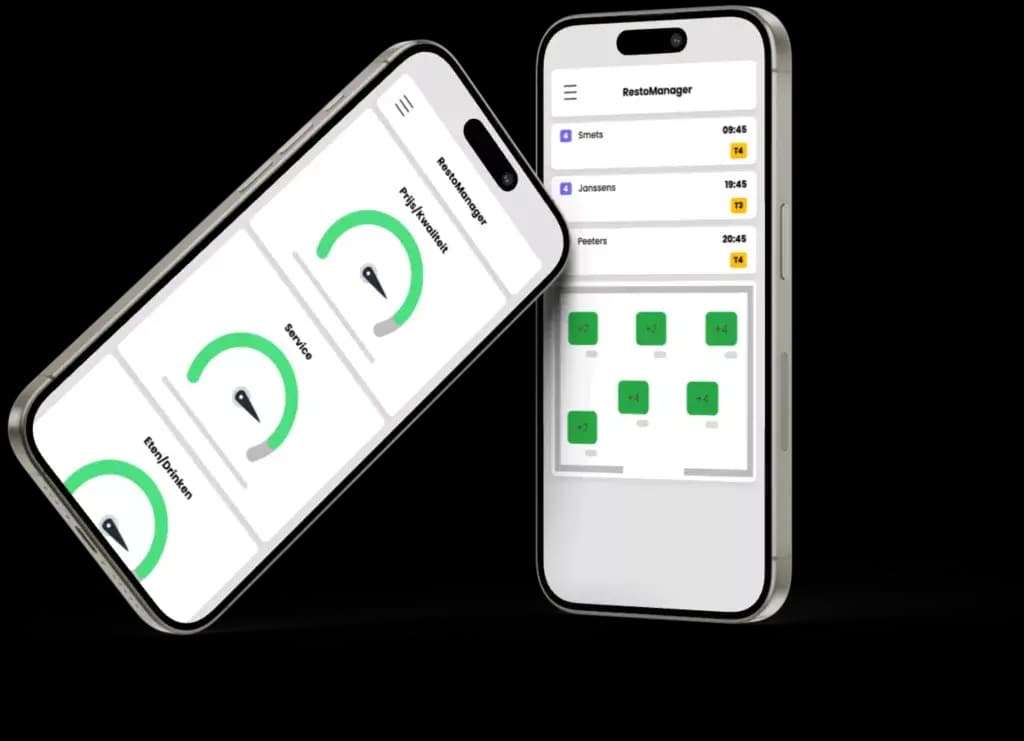
Do you want this marketing foundation to genuinely start running by itself, without separate tools, manual checklists or ad hoc campaigns? With RestoManager you combine online reservations, customer database (reservations + gift vouchers), review follow-up and more in one system, so you have more time for service on the floor while simultaneously creating more repeat visits.
Book a short demo and discover which flows (such as "We miss you", birthday, review invitation and "last tables") have the greatest impact for your restaurant.
Frequently Asked Questions
What is the best marketing for a restaurant in Belgium? The best marketing for a restaurant in Belgium starts with local findability: a complete Google Business Profile, a fast website with online reservations and a strong review routine. After that, you build repeat visits through email marketing (newsletters per region) and automation, so you become less dependent on social media and last-minute promotions.
How do I get my restaurant to rank higher on Google Maps? To rank higher on Google Maps (local SEO), your profile must be relevant and complete: correct category, consistent contact details, recent photos, an up-to-date menu and regular reviews with responses. The better your profile matches search queries in your city or neighbourhood, the greater the chance you appear more frequently.
What is "Reserve with Google" and how do I activate it? "Reserve with Google" allows guests to book a table directly via Google Search or Google Maps. This works through an end-to-end integration partner: your reservation system must be able to pass availability to Google. Whether it is available depends on your reservation partner and the supported integration.
What tools do I need to get more reservations? To get more reservations, you generally need five core tools: (1) Google Business Profile, (2) a website with a clear "Reserve" button, (3) an online reservation system, (4) review and reputation management, and (5) email marketing with segmentation (preferably per region). Together, they reduce friction and increase your conversions.
Does a newsletter still work for restaurants? Yes. A newsletter works especially well when you communicate relevantly: per region, per type of guest (regular, dormant, win-back) and with a clear call-to-action to book. The goal is not to "send more emails", but to encourage repeat visits with short, practical updates such as menu changes, events and "last tables".
How do I build a customer database as a restaurant? You build a customer database through reservations and gift vouchers: everyone who makes a reservation or purchases a gift voucher enters your database (with proper consent and the option to unsubscribe). You can then segment by region and behaviour, so you can communicate more precisely without a spam-like feel.
How do I reduce no-shows at my restaurant? You reduce no-shows with a combination of a clear reservation flow, confirmations and reminders, and possibly a cancellation policy. Automated reminders (email or SMS) at the right moment are often one of the fastest ways to reduce no-shows without having to communicate aggressively.
What is the fastest marketing win for a restaurant this month? The fastest win is usually: updating your Google Business Profile, adding a clear "Reserve" button to your website and activating an automatic review invitation 24 hours after a visit. These three simultaneously improve your visibility, conversions and trust, without requiring you to produce "more content".