In this article we will explore this through a range of practical tips on how you can introduce A.I. in your restaurant!
A.I. sounds exciting to many people, and perhaps even more so for hospitality entrepreneurs. Because personal hospitality and artificial intelligence… do they really go together?
The short answer: yes, absolutely.
Key Takeaways
- A.I. in the restaurant industry increases efficiency and gives hospitality entrepreneurs more time for their guests.
- 10 applications of A.I. improve processes such as reservations, communication and administration.
- RestoManager supports A.I. by optimising data and processes within restaurant operations.
- Kiosks and self-service create a faster customer experience without compromising on hospitality.
- A.I. does not replace hospitality, but supports it and creates space for genuine customer service.
Introducing A.I. in Your Restaurant: 10 Applications That Deliver Immediate Results
The A.I. applications for the restaurant industry listed below are deliberately brief and scannable. After reading, you can easily decide which area you want to start with today.
1. Automating Phone Calls & Questions During Peak Times
- Let A.I. answer standard questions (opening hours, location, parking, menu, availability).
- Ensure allergen questions are always handled safely: A.I. provides information but refers to your team when in doubt.
- Use this especially during service, when one phone call can disrupt a table just at the wrong moment.
Be sure to check out RestoManager's Reserve A.I. for this!
2. Smarter Reservation Management
- Faster confirmations and reminders reduce no-shows.
- Smarter table management helps improve occupancy without feeling "crammed".
- Less manual work for changes or cancellations means less stress at the bar or pass.
3. Optimising Staff Scheduling
- A.I. can predict busy periods based on reservations, trends and seasons.
- You create more realistic rosters: less overstaffing, less understaffing.
- Especially useful on peak days and events, where you'd otherwise often have to rely on gut instinct.
4. Managing Inventory and Purchasing
- Predictions on popular items help reduce waste.
- You buy more selectively, especially for fresh produce.
- Less "we suddenly ran out of…" and less "we're throwing away again…".
5. Analysing Reviews and Feedback
- A.I. detects patterns in compliments and complaints (waiting time, service, acoustics, price-quality).
- You identify more quickly what is genuinely structural versus a one-off outlier.
- This makes it easier to choose improvement actions that actually make a real impact.
6. Personalised Communication
- Recognising and personally approaching regular guests (without having to remember everything yourself).
- Birthdays, anniversaries or "long time no see" moments become opportunities to make warm contact.
- This is precisely where A.I. does not replace hospitality, but supports it.
7. Accelerating Content Creation (With Final Editing)
A.I. can be very helpful in writing copy, coming up with creative angles and drafting social media or email content. To keep this truly efficient, it is important that you understand how to communicate with A.I. It can sometimes seem as if A.I. truly understands us, but A.I. does not interpret language the way people do. Keep these points in mind:
- Create context A.I. does not know your restaurant, history or style. So provide as much information as possible and explicitly state the desired tone of voice.
- Use clear and direct language Metaphors and idioms are confusing for A.I. Be specific about what you are asking.
- Use action-oriented words Clearly state what you want: "write", "generate", "inspire", "structure".
- Always remain the final editor Never copy text directly. You remain responsible for everything you communicate.
In addition to content creation, A.I. can also perfectly support the development of a content calendar or the generation of new ideas.
8. Centralising Internal Knowledge
- Turn SOPs, onboarding and work instructions into one "smart handbook".
- New employees get up to speed faster, with less pressure on your established team.
- Consistency increases: everyone follows the same workflow, even when things get busy.
9. Upselling and Menu Suggestions
- Smart suggestions based on season, margins and popular combinations.
- Think "aperitif + snack", "dessert with coffee", or an alternative when something is sold out.
- The goal is not to push, but to help guests choose, that feels hospitable.
10. Reducing Administration
- Quick summaries of performance, trends and busy periods.
- Less time spent on reporting and "gathering everything together".
- More time for the floor, and that is where your guests feel your presence.
A Bonus: Personalising Guest Experiences with A.I.
Kiosks are now everywhere. Not just in fast food chains, but increasingly in all kinds of hospitality concepts. And for good reason.
They automate tasks previously performed by staff and often increase efficiency without guests even consciously noticing. Think of self-checkout machines in supermarkets or mobile kiosks integrated into apps.
Research shows that:
👉 60% of consumers prefer to use self-checkout
👉 46% would like to see even more self-service points
This shows that technology is playing an ever greater role in the customer experience, provided it is used well. A.I. does not replace hospitality, but supports it.
- Speed up ordering moments without a "cold" experience: A.I.-driven kiosks and self-service take over repetitive steps, so your team has more time for genuine hospitality.
- Make self-service personal (rather than anonymous): let A.I. take into account favourites, repeat orders, preferences and allergens (always with a clear safety check and the option for human follow-up).
- Offer freedom of choice: for guests who prefer human contact, a classic ordering route remains important. So combine self-service with a clear "talk to us" option.
- Use self-service primarily where it adds the most value: peak times, lunch rush, take-away and quick payments.
Kiosks are now everywhere. Not just in fast food chains, but increasingly in all kinds of hospitality concepts. And for good reason. They automate tasks previously performed by staff and often increase efficiency without guests even consciously noticing.
Research also points to a clear shift in expectations: 61% of kiosk users say they want to see more kiosks in restaurants. restaurantdive.com In addition, consumer research shows that many people choose self-checkout for speed and convenience (e.g. 77% choose self-checkout for faster service in a survey by NCR Voyix). ncrvoyix.com+1
The key point: A.I. does not replace hospitality, but supports it, provided you deploy it as a "fast route" for those who want it, and free up your team for attention, advice and atmosphere.
Where Does RestoManager Fit In?
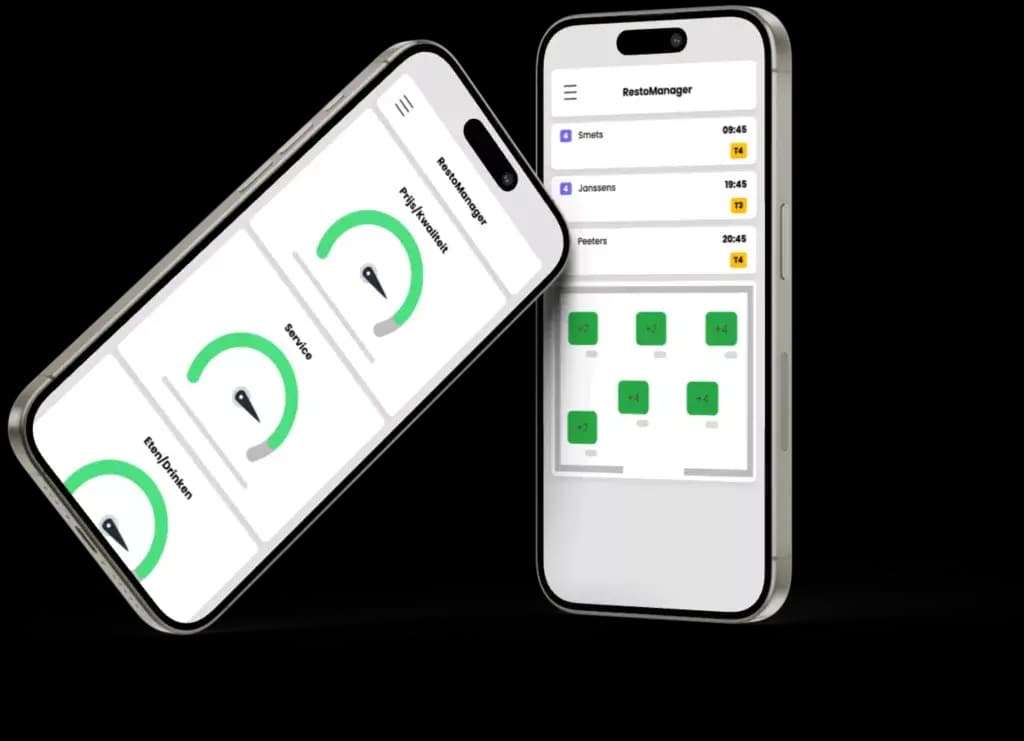
A.I. works best when it can rely on good data and processes that are already solid. And that is where RestoManager logically comes into the picture: it is the foundation where reservations, guest data and communication come together, so A.I. does not operate in isolation but can truly function as part of your daily operations.
Reserve A.I.: Phone Peace During Your Busiest Moments
Our Reserve A.I., which we have been offering for some time now, is being very positively received.
Reserve A.I. is a smart phone function you can activate during busy shifts. The A.I. knows your business through RestoManager and can:
- answer guest questions
- make reservations
- modify or cancel reservations
Without you or your team needing to pick up the phone or enter anything manually. This keeps the focus where it belongs: on the guests in the restaurant.
Conclusion:
A.I. in the restaurant industry is not about less humanity, but about more space
A.I. in the restaurant industry is not about less human contact, but about more room for genuine hospitality. Less peripheral work, more attention. Precisely what the hospitality industry is all about.
A.I. does not replace hospitality, but supports it, provided that you safeguard the style, set clear boundaries and ensure your team always retains ownership of the interaction.
And that is precisely where RestoManager helps you: technology that works in the background, so you have all the space you need for your guests.
Will A.I. take over jobs in the restaurant industry? A.I. will primarily automate repetitive tasks (phone handling, administration, scheduling). In restaurants, human contact remains essential. In practice, teams use A.I. mainly to reduce workload and make service more consistent.
What possibilities does A.I. offer in the hospitality sector? A.I. is used for chat and phone assistance, automated reservation flows, prediction-based scheduling, review analysis, marketing personalisation and waste reduction through inventory and demand forecasting.
Cost savings through A.I.: is it possible? Yes. A.I. can save costs through less waste (inventory), more efficient rosters (staff scheduling) and fewer no-shows (reminders and policy). That translates directly to margin and peace of mind.
Which restaurants are using A.I.? Both chains and independent restaurants use A.I. for operational efficiency and guest communication. Chains experiment more with self-service and voice technology; in practice, restaurants primarily use A.I. for phone handling, reservations, scheduling and personalised marketing. Examples include KFC and Taco Bell, but also restaurants in Belgium that are already using Reserve A.I., they are the trailblazers!